
Imagine going on a run one spring afternoon. You pass by a vibrant garden. This flourishing scene is made possible by antioxidants and amino acids — essential nutrients that nurture not only our bodies, but also the soil we depend on.
Like skilled gardeners, these compounds support our immune systems, reduce inflammation and aid protein production. Unfortunately, recent changes in farming and environmental conditions, such as soil depletion and new emerging contaminants, have led to a decline in these important nutrients in our crops.
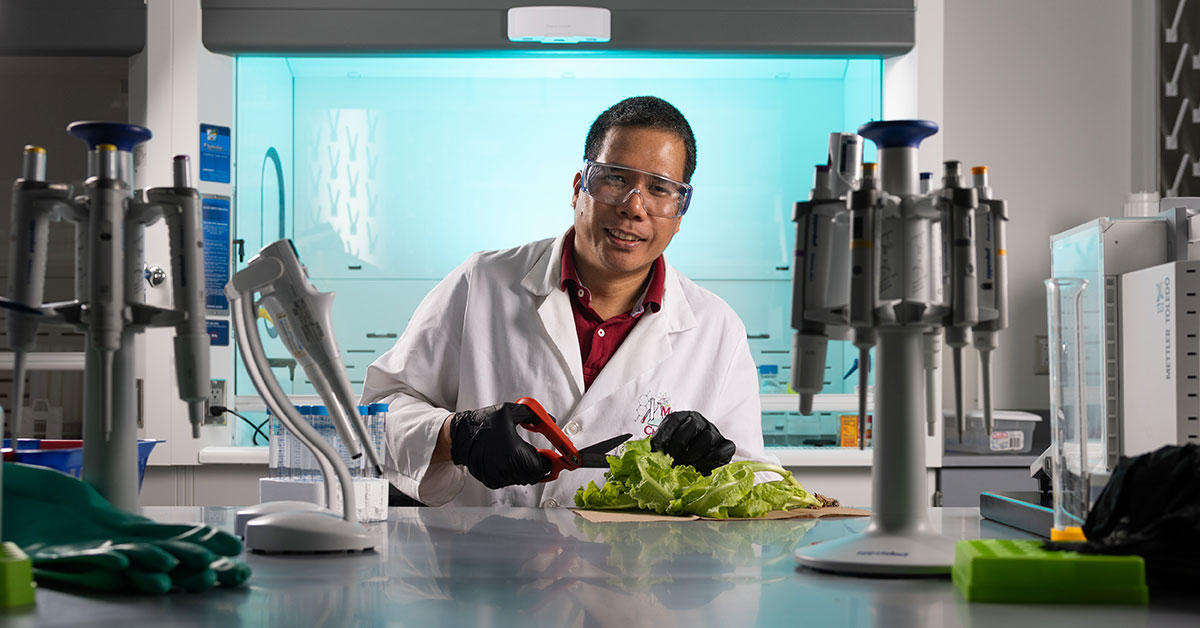
To address this, Dr. Cyren Rico, Roy D. Blunt Life Science Endowed Professor in Missouri State University’s department of chemistry and biochemistry, uses state of the art methods of measuring nutrients. His goal is to better measure and improve the nutritional quality of our food.
Revolutionizing nutrient measurement
Rico focuses on accurately measuring antioxidants and amino acids in plants such as wheat and barley — even at very low levels. His research efforts could change how we understand plant nutrition and food security.
“Precision in measuring these nutrients is crucial. It helps us improve the nutritional value of our crops.”
Instead of measuring crop nutrition in a traditional way, which often involves soil testing for nutrient levels and plant tissue analysis, Rico’s lab studies how plants respond to pollutants. He and his team look at characteristics of plant growth and productivity, such as height, biomass and yield. They also perform tests that check chlorophyll content, enzyme activity and stress levels.
To measure growth, for example, they use a meter stick for height and a balance scale for weight and yield. While these tools may seem simple, these measurements are part of a larger, highly controlled process that tracks subtle changes in plant health and productivity over time.
By carefully monitoring growth, the team gains critical insights into how plants respond to environmental stressors, ultimately helping to improve crop resilience and nutritional content.
To conduct biochemical tests, they collect plant parts, such as leaves. The team grinds the leaves into a powder to mix with a liquid nitrogen solution for analysis. They use an analytical technique called inductively coupled plasma mass spectrometry (ICP-MS). In this process, Rico and his team dry and study plant parts, such as roots and shoots, to understand how pollutants affect plants’ absorption of elements.
“The sensitivity of ICP-MS allows us to detect changes in elemental content at parts per trillion,” Rico said. “This is crucial for understanding how pollutants affect the absorption of essential elements, such as calcium, magnesium and iron in plants.”
They use liquid chromatography mass spectrometry, another advanced analytical technique, to study metabolites, small molecules produced during metabolism. The researchers analyze changes in antioxidants, amino acids, sugars, lipids and other compounds. The data offers valuable insights into how plants adapt to harmful substances.
By studying the elemental and metabolite contents with such precision, the team can determine not just how pollutants interfere with the uptake of vital nutrients, but also how much of these harmful substances are absorbed by the plants. This in-depth analysis provides insights into the complex relationship between pollutants and nutrient absorption, allowing the researchers to understand how even trace amounts of contamination can disrupt plant health, growth and productivity.
Developing this method has not been easy. The team faced challenges with complex equipment and the repetitive nature of the experiments. The process can take several months, starting with growing plants in contaminated soil and collecting data during different growth stages.
Rico has more than 50 publications to his name to support his work. His students have also been active in research, delivering more than 50 presentations at local, regional and national conferences.
Mary Fakunle, a chemistry graduate student, works in Rico’s lab. Since joining, she has conducted research on the impact of nanoparticles used as fertilizers on plant growth and nutrition. This hands-on work has deepened her understanding of environmental chemistry. It’s also honed her analytical skills, preparing her for a future career dedicated to sustainability.
“Dr. Rico pushes you to do something different and encourages you to achieve your best,” Fakunle said. “It’s one thing to have an advisor; it’s another thing to have an advisor who nurtures your curiosity and challenges your thinking.”

Exploring plant epigenetics
Rico’s research also looks at the long-term effects of pollutants by studying multiple generations of plants. Known as epigenetics, this area of research explores how parent plants influence their offspring.
This involves observing how the first generation produces seeds. Then, those seeds are grown and exposed to the same pollutants in the following generations.
“We aim to understand the long-term effects of contaminants on plants and how they recover from stress,” he said. “We want to see if a stress, like a decrease in grain yield or certain metabolites, is consistently observed down the generations of plants previously exposed to the contaminant.”
Impacting food security
What drives Rico’s research is his desire to improve global food systems. Accurate data is essential for creating effective strategies to improve food and nutrition worldwide.
“Improving tests for plant metabolites (i.e., antioxidants, amino acids, sugars, lipids) could boost crop nutrition, helping to tackle global food security issues,” he said. “In areas with limited access to diverse, nutrient-rich foods, this research could lead to better food quality.”
Crops with better nutritional content can have a direct effect on public health. Healthier populations are less likely to suffer from diet-related diseases, he said. For example, crops rich in antioxidants can boost immunity. Increased amino acids can support growth and repair in children and adults.
Looking ahead
Rico’s advancements mark an important step in agricultural science. He hopes to work with agricultural organizations and policymakers to apply his findings on a larger scale. His team is also exploring ways to adapt these techniques for other crops and incorporate them into sustainable agricultural practices.
“Our work demonstrates how scientific progress can make a meaningful difference, ensuring better food quality and healthier lives.”
Further reading
Discover more from Mind's Eye
Subscribe to get the latest posts sent to your email.
Leave a Reply